


1. A suitable straight edge
This setup is for suitable straight-edge kitchen knives. It does not sharpen serrated blades or repair chipped or badly damaged edges.
FREE US SHIPPING
30-DAY KEEP-IT GUARANTEE
25% OFF · NOW US$59.99
FREE US SHIPPING
30-DAY KEEP-IT GUARANTEE
25% OFF · NOW US$59.99
FREE US SHIPPING
30-DAY KEEP-IT GUARANTEE
25% OFF · NOW US$59.99
FREE US SHIPPING
30-DAY KEEP-IT GUARANTEE
25% OFF · NOW US$59.99
FREE US SHIPPING
30-DAY KEEP-IT GUARANTEE
25% OFF · NOW US$59.99
FREE US SHIPPING
30-DAY KEEP-IT GUARANTEE
25% OFF · NOW US$59.99
FREE US SHIPPING
30-DAY KEEP-IT GUARANTEE
25% OFF · NOW US$59.99
FREE US SHIPPING
30-DAY KEEP-IT GUARANTEE
25% OFF · NOW US$59.99
FREE US SHIPPING
30-DAY KEEP-IT GUARANTEE
25% OFF · NOW US$59.99
FREE US SHIPPING
30-DAY KEEP-IT GUARANTEE
25% OFF · NOW US$59.99
FREE US SHIPPING
30-DAY KEEP-IT GUARANTEE
25% OFF · NOW US$59.99
FREE US SHIPPING
30-DAY KEEP-IT GUARANTEE
25% OFF · NOW US$59.99
🛡 30-DAY FULL REFUND · YOU KEEP THE SHARPENER
4.6· 463 reviewsCouldn't load pickup availability
✓ Restores the knives you'd already written off
✓ The block holds the angle, so you can't get it wrong
✓ 30-day full refund. Nothing to send back

Secure checkout

Finally, I can sharpen the knife I already like without learning a whole new skill.

This looks simple enough that I’d actually use it instead of letting another gadget collect dust.

I like restoring a good knife instead of replacing it, and this would make a genuinely useful gift.


SEE THE SETUP IN 11 SECONDS
No mystery motion. See how the blade, guide and roller work together before you choose your setup.
KNOW THE FIT BEFORE YOU BUY
Start with the blade you actually use for dinner. These checks matter more than the name on the handle.
This setup is for suitable straight-edge kitchen knives. It does not sharpen serrated blades or repair chipped or badly damaged edges.
The blade must be held securely by the magnetic guide. If it will not sit steadily, do not force the setup.
The abrasive face must reach the cutting edge. Choose the 15° or 20° face to match your knife maker’s guidance, rather than guessing from the knife’s name.
Unsure about your knife? Email support@keldley.com before ordering.
The knife in your drawer that "doesn't cut anymore" is almost certainly fine. It has just lost its edge. Getting it back takes about sixty seconds at the correct angle, with no skill you don't already have.
THE PROBLEM
Sharpening means grinding two bevels until they meet in a clean line. That requires holding the blade at the same angle, fifteen or twenty degrees, for every single pass.
Hands don't do that. Not yours, not anyone's. A wrist drifts a few degrees without you feeling it, and a few degrees is the difference between an edge and a rounded shoulder of steel.
So you're left choosing between a pull-through sharpener that takes years off the knife, or a whetstone that asks you to hold an angle by hand. That is the exact thing that was hard in the first place.
That's not a competence problem. It's a geometry problem.

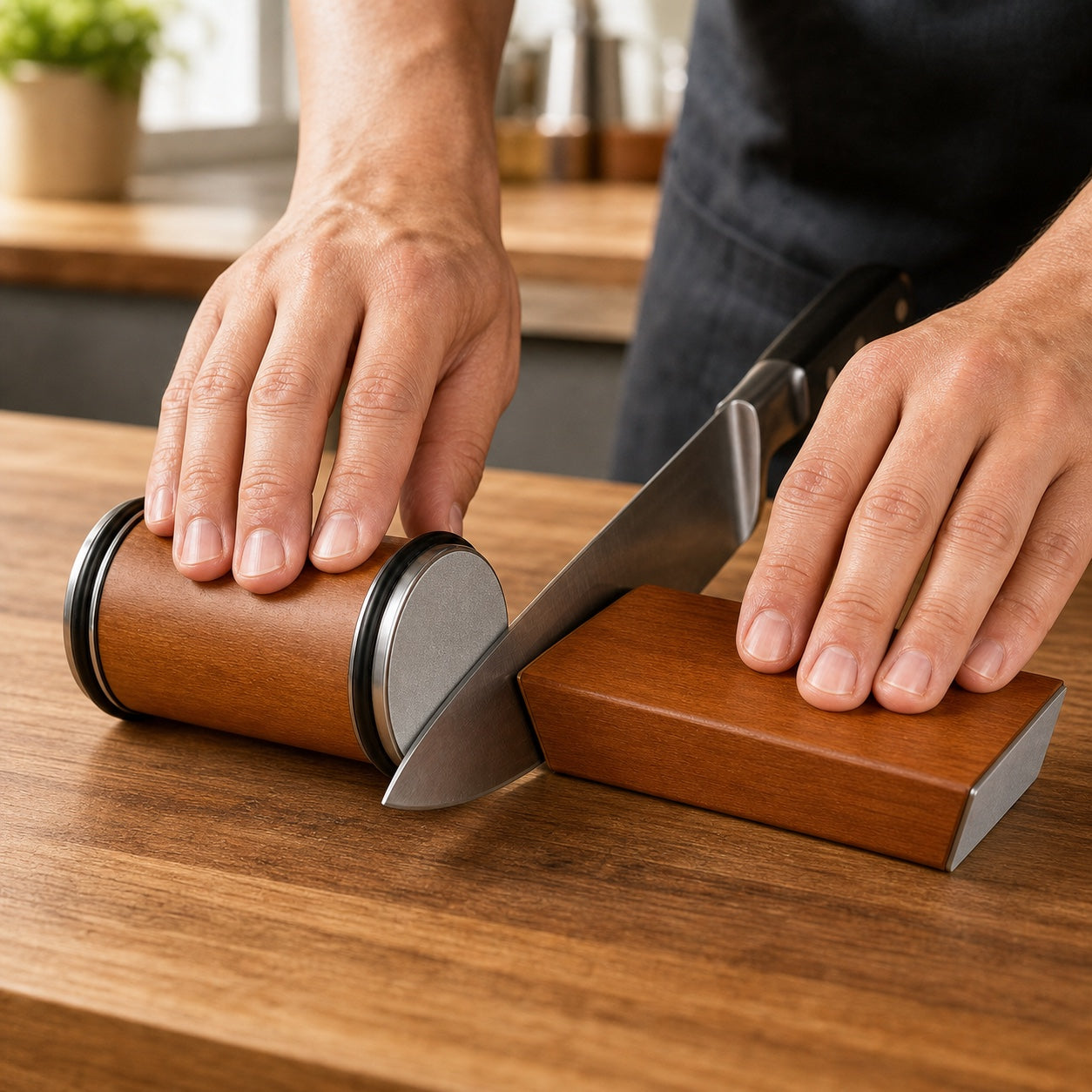
Choose the 15° or 20° face to match your knife manufacturer’s guidance. Seat a suitable blade securely against the magnetic guide and check that the abrasive face reaches the edge.

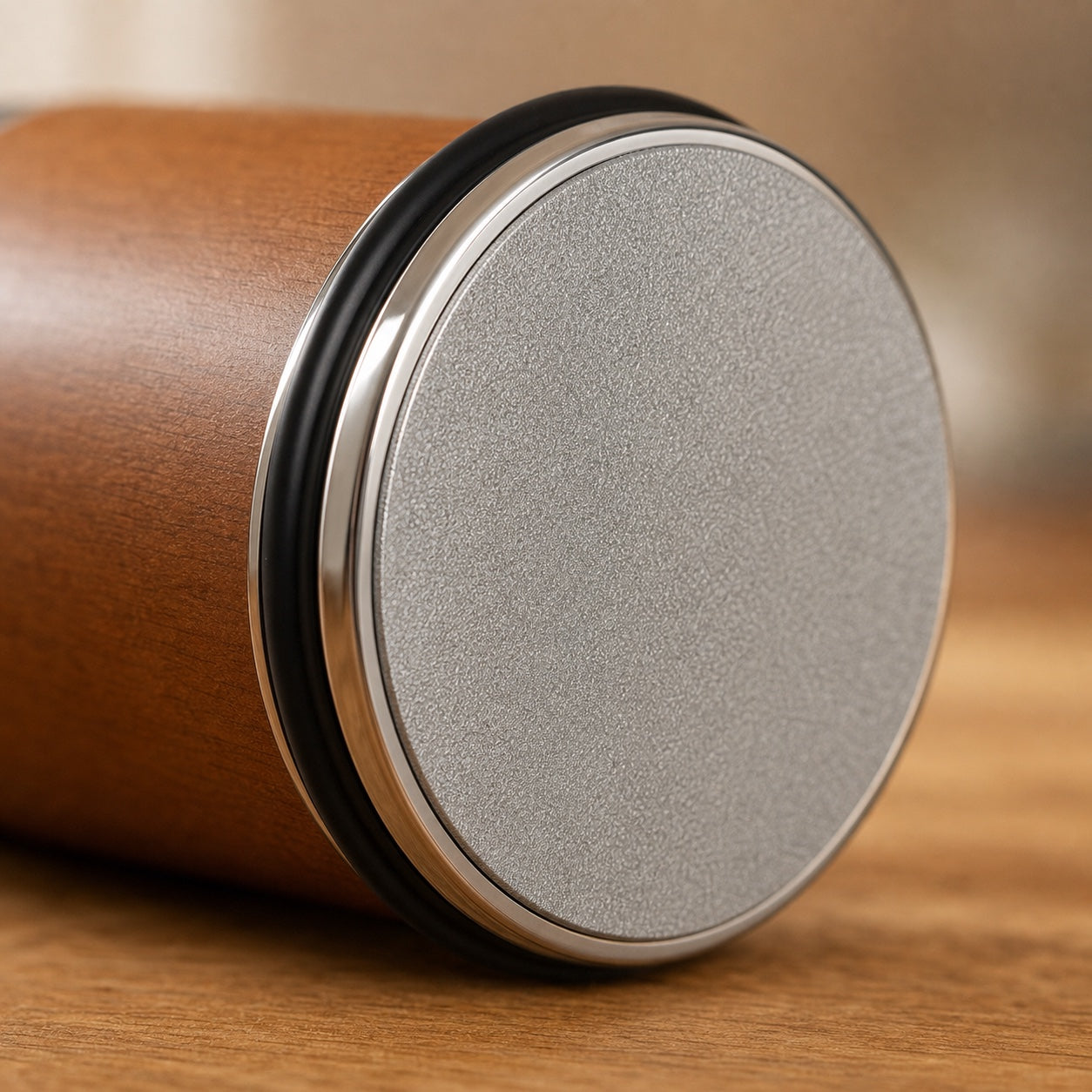
Run the coarse 400-grit diamond face along the edge, eight to ten passes a side. The weight does the work. Then flip the roller and repeat with the fine 1000-grit face to refine the bevel it just rebuilt.

Paper first, then a tomato. Because the angle never moved, every pass landed in the same place. That's why this works on the first attempt instead of the fiftieth.
WHAT ARRIVES
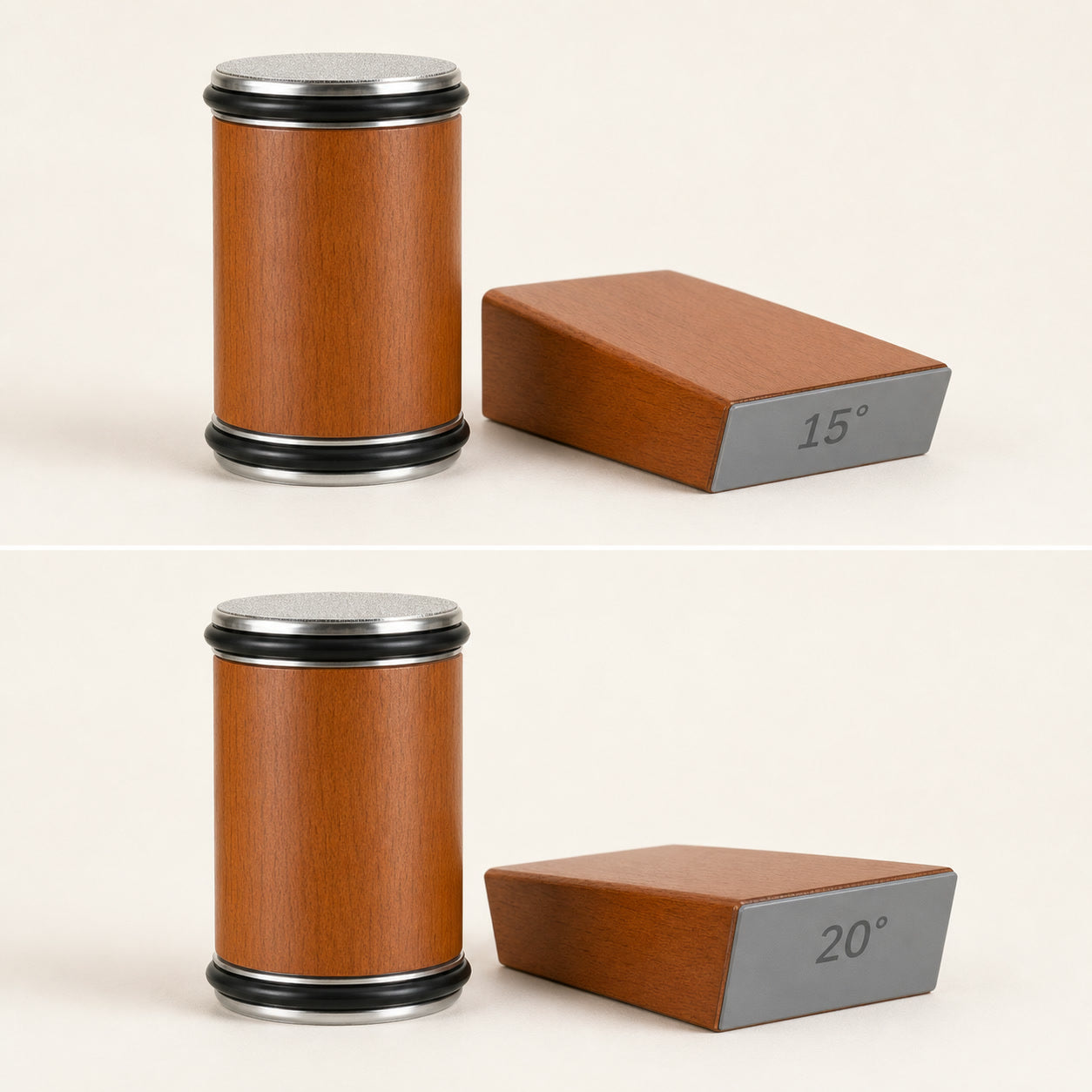
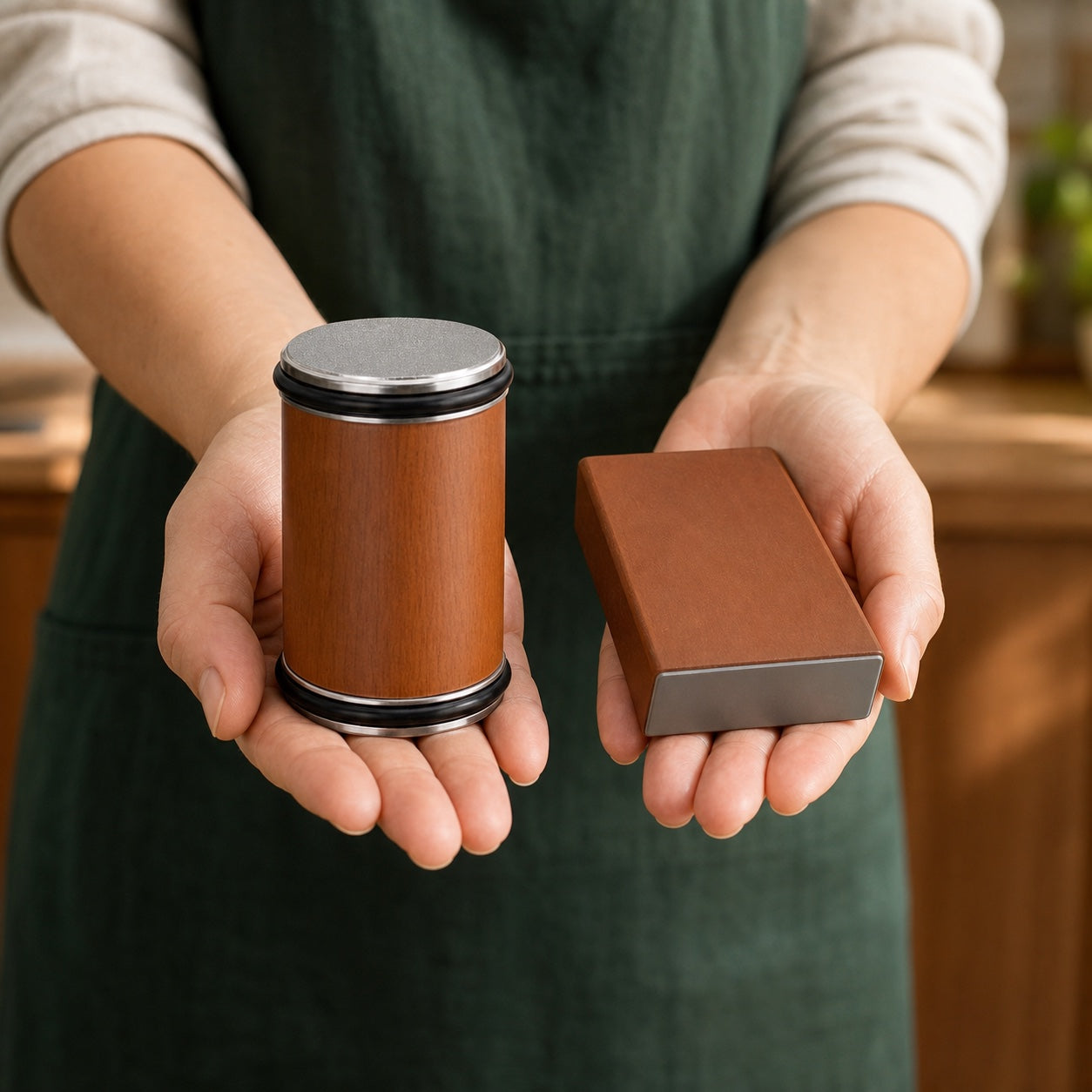
Your kit includes the wooden roller with 400-grit and 1000-grit abrasive faces, plus the magnetic angle guide with 15° and 20° faces. Use the coarse face for sharpening and the finer face to refine the edge, following the product instructions.
Clean sharpening residue from the knife before food preparation. Then put your knife back to work on the meal you wanted to make.
SHARP VS. DULL

Illustrative concept — not a test of this unit.
THE HONEST METHOD COMPARISON
A pull-through looks simple and a whetstone offers full control. Keldley takes the useful middle: a guided angle without forcing the blade through an enclosed slot or learning to hold that angle by hand.
GUIDED CONTROL
Fixed-angle rolling
SKILL-LED CONTROL
Traditional freehand sharpening
FIXED-SLOT SHORTCUT
Blade drawn through abrasives
Whichever method you use: abrasive sharpening removes a small amount of steel. Always clean the blade before it touches food.
CUSTOMER REVIEWS
4.6/5
463 customer reviews
The tomato in my picture is the one that convinced me. Before sharpening, the knife pressed the skin flat; afterward, the first cut started cleanly. I used 400 grit followed by 1000 and kept the rolls light. Very satisfying result on a normal straight-edge knife.
The paper in my picture shows the post-test result: a clean diagonal cut instead of shredded fibers. I used the 400-grit face first and a lighter 1000-grit finish, and the difference was obvious. The guided angle made the test repeatable.
The knife drawer in my picture had three blades I kept avoiding. I worked on the straight-edge chef's knife first, then the utility knife, and put both back in rotation. The 20-degree side and fine finish made the biggest difference, especially on the wider blade where the magnet held it securely. I did not try to force the process on the serrated blade; it stayed untouched because this sharpener is for straight edges. Finally, the drawer is full of tools I reach for instead of tools I tolerate.
Most sharpening tools look like workshop equipment. This one sits comfortably beside my cutting boards, and the roller feels more substantial than it looks. More important, it restored a clean edge to our everyday chef's knife. The countertop photo is basically where it lives now.
I posted close-ups of both faces because the textures are genuinely different. The 400-grit side did the heavier work on my straight-edge chef's knife; the 1000-grit side refined the edge afterward. The knife cuts better now, though the final passes took patience. Four stars for a good result that is not completely automatic.
The small paring knife was a tougher test than my chef's knife because there is less blade for the magnet to hold. Once I settled it against the block, the 15-degree side produced a clean edge. Good result, just not quite effortless on a narrow blade.
My main chef's knife had started sliding on onion skin, so I finally sharpened it. I used the 20-degree side, then the fine face, and the tip now starts the cut exactly where I place it. The edge feels calm instead of jumpy during prep.
I lined up three straight-edge kitchen knives and worked through them one at a time. The 15- and 20-degree choices made it easy to match each blade, while the 400/1000 grit faces gave a sensible coarse-to-fine finish. One needed another round, but all three ended noticeably sharper.
Bought this after my third cheap pull-through sharpener did nothing but roll the edge over within a week. The idea is that you rest the blade against the block at a fixed angle (20° side for my chef's knife) and just roll it back and forth, which sounds too simple to work but actually does. Coarse end about ten passes per side, flipped it, few passes on the fine end — done in under two minutes. Did the paper test after: clean cut through a single sheet of copy paper without dragging. Rescued a chef's knife that was basically a doorstop.
I don't have time for Japanese water stones (tried one, gave up). This is stupid simple. The knife literally sticks to the block — magnetic, you feel it click into place against the angle face — and then you roll back and forth like you're sharpening a bread knife by hand. Eight passes per side on the rough end, flip the roller, a few on the fine end, done. My santoku went from 'I'm never using this' to slicing tomatoes with zero pressure in about ninety seconds.
Does exactly what it says for straight-edged blades. My chef's and paring are sharp as glass. I did try it on my bread knife hoping the magic would carry over to the teeth and… it doesn't do serrated, which is fair but only mentioned in small print. That's on me more than them — just wish it was clearer before you buy. If everything in your kitchen is straight-edged, this gets five stars from me.
I'm 68 and my hands were never great at holding an angle; pull-through sharpeners always scraped my fingers against the blade while I worked. The block does that part for you — press it in, it holds, all I do is roll back and forth with no wrist work. My paring knife was so dull I could feel every pass as it found its edge again. Cuts paper clean now. Only advice: make sure your blades are actually straight-edged before blaming this thing.

THE GUARANTEE
Take the dullest knife you own, the one you'd already written off, and use Keldley on it. If it doesn't come back sharp, email us within 30 days and we'll refund you in full.
You don't need to explain yourself, and you don't need to post anything back. Your refund is not conditional on sending the sharpener back.
No. It removes far less metal than a pull-through sharpener, because it cuts at a set angle instead of forcing the blade through a fixed slot.
It's the opposite. The block holds the angle, which is the only genuinely hard part of sharpening. If you can roll a rolling pin, you have every skill this requires.
It will not sharpen serrated blades, and it will not repair a chipped or badly damaged edge. That needs professional regrinding. We'd rather tell you that now than in a refund email.
US orders ship free from our US warehouse. Most orders are processed within 1–3 days. Estimated delivery is 3–7 days after dispatch.
These are estimates, not guaranteed delivery dates. We email your tracking link as soon as your order is on its way.
Email us within 30 days of delivery with your order number. We refund you in full, usually within 3 business days, and you keep the sharpener. No return label, no forms, no explaining. It's offered in good faith, and repeated claims from the same customer may be declined.
Roller: 8.4 cm tall, 5.5 cm diameter, with dual diamond faces: coarse 400 grit (46 micron) on one end, fine 1000 grit on the other.
Angle block: 10.4 × 5.7 × 2.4 cm, magnetic, with fixed 15° and 20° faces on opposite ends.
Weight: about 380 g together.
Materials: wood body, metal faces and fittings.
Keldley is a small company that sells one product and answers its own email at support@keldley.com, within one business day, Monday to Friday. The keep-it guarantee exists so you don't have to take our word for anything.
You don't need new ones. You need about a minute each, at the right angle.
$59.99 · Free US shipping · 30 days to change your mind · Nothing to post back